
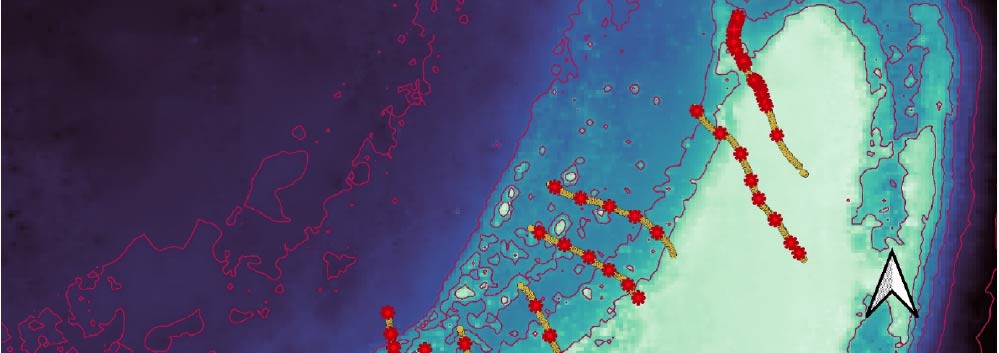
Researchers towed a BlueROV2 for surveying benthic communities as a faster, deeper alternative to traditional snorkel and SCUBA surveys. Where a dive pair covers around 1,000 m² per day, the towed ROV can cover over 38,000 m² per day at depths of 2–60 m. The ROV produces geo-referenced video and imagery, supports organism measurement via orthomosaics, and logs physical data like depth and temperature.
Abstract: Surveying benthic communities has historically relied on snorkel or SCUBA, but these methods are labour-intensive, inefficient (∼1000 m2 per day covered for one dive pair) and depth-limited (<30 m depth). Here we detail a remote method using a towed mini-ROV that combines the depth capabilities and endurance of towed cameras with the flexibility and manoeuvrability of SCUBA and snorkel. Towed mini-ROV allows over 10 km of transects or 38,000 m2 of benthic surveys per day, produces data that can be geo-referenced, allows measurement of organisms using orthomosaics, can include physical data such as depth and temperature, and can operate from depths of 2–60 m without any gear changes. This setup requires only modest modifications of readily available equipment, and is relatively low-cost given the time and labour efficiencies gained. We provide some examples of the types of data that can be produced (video, imagery, spatial layer), as well as the sort of coverage that is realistic using real survey data obtained from the Great Barrier Reef, Australia. Results demonstrate this approach could be used on a large scale to rapidly survey benthic environments. It could be further improved by using a more hydrodynamic ROV design, and a more streamline pipeline that integrates data sources. Use of underwater positioning systems could improve spatial parameters, lasers could improve measurement accuracy, and additional cameras could increase spatial coverage, but at the cost of added complexity and hydrodynamic drag.
Authors: Raoult, V.; McSpadden, K.; Gaston. T.F.; Li, J.Y.Q.; Williamson, J.E.
Journal: Marine Environmental Research, Volume 208
To read more, click here!