
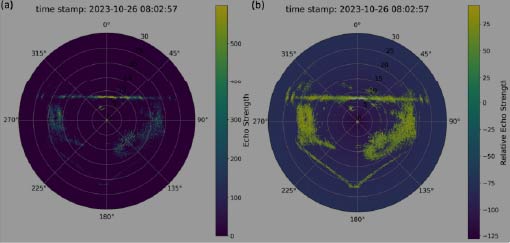
Researchers deployed the Ping360 Scanning Sonar to monitor Atlantic salmon in a commercial sea cage during the first six weeks after sea transfer, a period of elevated stress levels and mortality. The study shows how the Ping360 can capture meaningful behavioral and cage deformation data in large-scale aquaculture settings, useful for informing parasite management strategies and fish welfare assessments.
Full Title: Monitoring behavior of post-smolts Atlantic salmon (Salmo salar) during their first month after sea transfer in a commercial sea cage using a mechanical 360-degree single-beam scanning sonar
Abstract: Understanding the behavior of Atlantic salmon (Salmo salar) in commercial sea cages is critical for developing effective strategies to manage parasites. It is particularly relevant since many preventive measures, such as lice skirts, snorkel cages, and submerged systems, aim to limit encounters between salmon and lice in the upper part of the water column. Furthermore, behavior is also a recognized welfare indicator, with deviations from normal patterns potentially signaling stress or disease. Despite its importance, behavioral baselines remain poorly defined, especially in large-scale production environments. This study investigates the use of a mechanical 360-degree single-beam scanning sonar (Ping360) to monitor the vertical and horizontal distribution of post-smolt Atlantic salmon (510 g on average) in a commercial sea cage during the first six weeks after sea transfer, a period associated with elevated stress and mortality. Unlike traditional single beam echosounders, which offer limited horizontal coverage, the Ping360 provides a broader field of view. The fish monitored in this study started to feed the day after their transfer and initially occupied the upper five meters of the water column, with no marked differences in day-night distribution outside some agitation and spreading in the cage center when feed was provided. Some schooling patterns along the cage walls formed after five days and became the main daytime behavior after two weeks. Feeding behavior also became more structured over time, with fish aggregating below the surface in the center of the cage and dispersing gradually as they became satiated. Salmon did not display a particular avoidance of the bottom or center of the cage. Additionally, cage deformation due to elevated current velocities and waves were visible on the sonar output. No major changes in fish distribution were observed under these conditions, except for one instance where salmon seemed to swim 1–2 m further away from the surface. Our findings demonstrate the potential of this low-cost, user-friendly sonar to capture informative behavioral and cage deformation data in large-scale aquaculture settings.
Authors: Sauphar, C.; Bolinches, P.; Gygax, L.; Tuene, S. A.; Aas, G. K. F. H; Gansel, L. C.
Journal: Aquaculture, Volume 620
To read more, click here!