
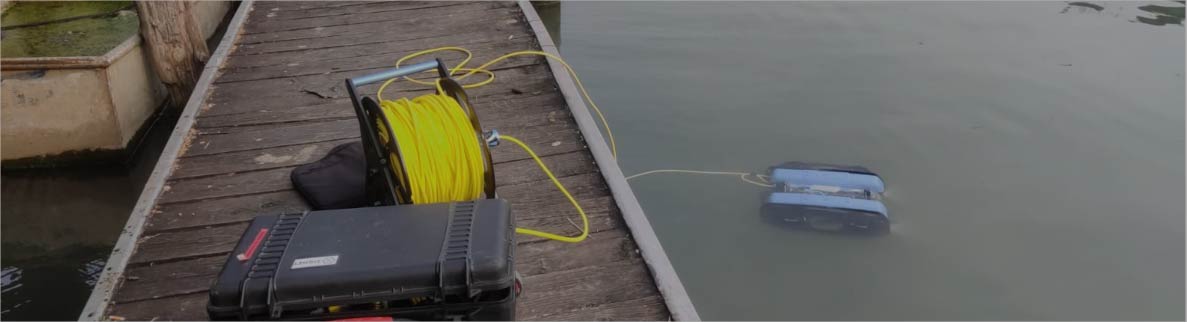
Researchers used a BlueROV2 Heavy to test tether-free teleoperation over underwater acoustic modems using ROS 2, no vehicle modifications required. Testing across sixteen configurations in both a lab tank and a real river deployment, they found BPSK outperformed FHSS on latency by 700 to 800ms, with both schemes delivering stable timing.
Abstract: Underwater robotic systems rely on acoustic communication due to the severe attenuation of radio-frequency signals in water, but the limited bandwidth, high latency, and strong channel variability of acoustic links significantly constrain teleoperation. This paper presents a ROS 2-based teleoperation architecture for control of a BlueROV2 Heavy platform over low-data-rate underwater acoustic channels.
The proposed system integrates software-defined acoustic modems with the rmw_desert middleware, achieving interoperability between ROS 2 nodes and underwater acoustic hardware without requiring modifications to the vehicle platform. Two modulation schemes, FHSS and BPSK, are experimentally evaluated across sixteen configurations in both a controlled laboratory tank and a shallow-water river deployment at approximately 85 m. Two experimental setups are used: one optimized for packet delivery rate assessment using high packet counts, and one providing sub-millisecond clock synchronization via hardware timing modules for latency and jitter evaluation. Performance is assessed in terms of packet delivery rate, end-to-end latency, and jitter using timestamped logs and bootstrap confidence intervals.
BPSK consistently achieves lower end-to-end latency than FHSS, with a median reduction of approximately 700 ms to 800 ms. Both schemes exhibit low and comparable jitter, with median values below 100 ms across all configurations, indicating stable timing under the evaluated command rates. All configurations exhibit multi-second end-to-end latency, reflecting fundamental constraints of the acoustic channel rather than system integration. These results demonstrate the feasibility of ROS 2-based acoustic teleoperation in real-world conditions and identify latency as the primary limiting factor in performance, providing guidance for the design of underwater communication stacks in bandwidth-constrained robotic systems.
Authors: Ferraresso, N.; Costa, D.; Varagnolo, D.; Campagnaro, F.; Zorzi, M.
To read more, click here!